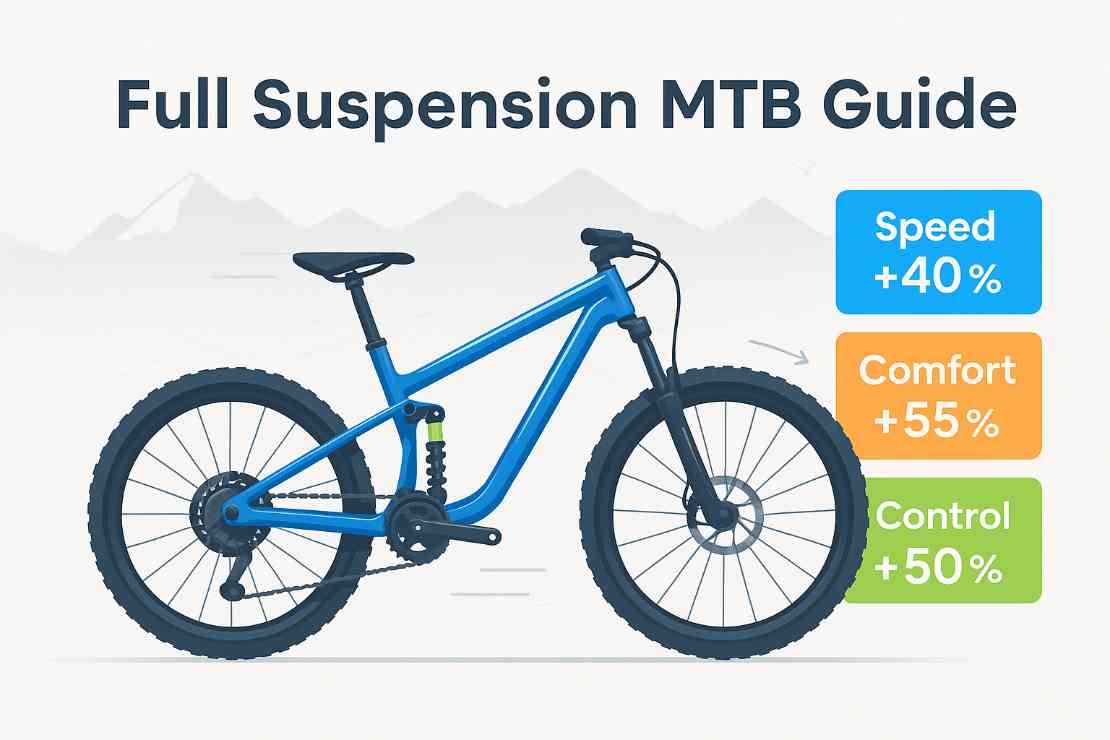
Full suspension MTB technology has transformed mountain biking from a bone-rattling challenge into a fast, fluid adventure. By coupling front and rear suspension, these bikes glide over roots, rocks and ruts, letting you focus on the thrill rather than the punishment. Whether you dream of epic alpine descents or flowy woodland single-track, a well-chosen full suspension MTB gives you the control, comfort and confidence to ride further and faster than ever before.
Introduction to Full Suspension Mountain Bikes
Unlike a traditional hardtail that relies on a front fork alone, a full suspension MTB uses both a suspension fork and a rear shock. The extra linkage keeps both wheels glued to the ground, absorbing impacts that would otherwise buck you off line. You’ll notice the difference the moment you hit rough terrain: the bike tracks smoothly, tyres maintain grip and your body takes far less abuse.
Different disciplines place different demands on a full suspension MTB:
- Cross-Country (XC) – focuses on efficiency and climbing speed, often running 100–120 mm of travel.
- Trail / All-Mountain – the all-rounders, with 120–150 mm of travel and balanced geometry.
- Enduro – prioritises descending while still climbing well, usually 150–170 mm.
- Downhill (DH) – built purely for gravity, sporting 180–200 mm of ultra-plush travel.
- Freeride – designed for jumps, drops and tricks; robust frames and mid-to-long travel.
Deciding where you sit on that spectrum shapes every choice that follows, from frame material to brake size. A quick test ride will reveal which style feels natural, but sizing is just as crucial. A frame that’s too small feels twitchy; too large saps agility. Check the manufacturer’s size chart, then take a spin to confirm reach, standover and cockpit comfort.
Common pitfalls are easy to avoid. Riders often buy on looks alone, forgetting to evaluate suspension type, brake spec or long-term maintenance. Take your time, measure twice and, ideally, demo different bikes before handing over hard-earned cash. The reward is a ride that feels tailor-made.
Benefits of Full Suspension Mountain Bikes
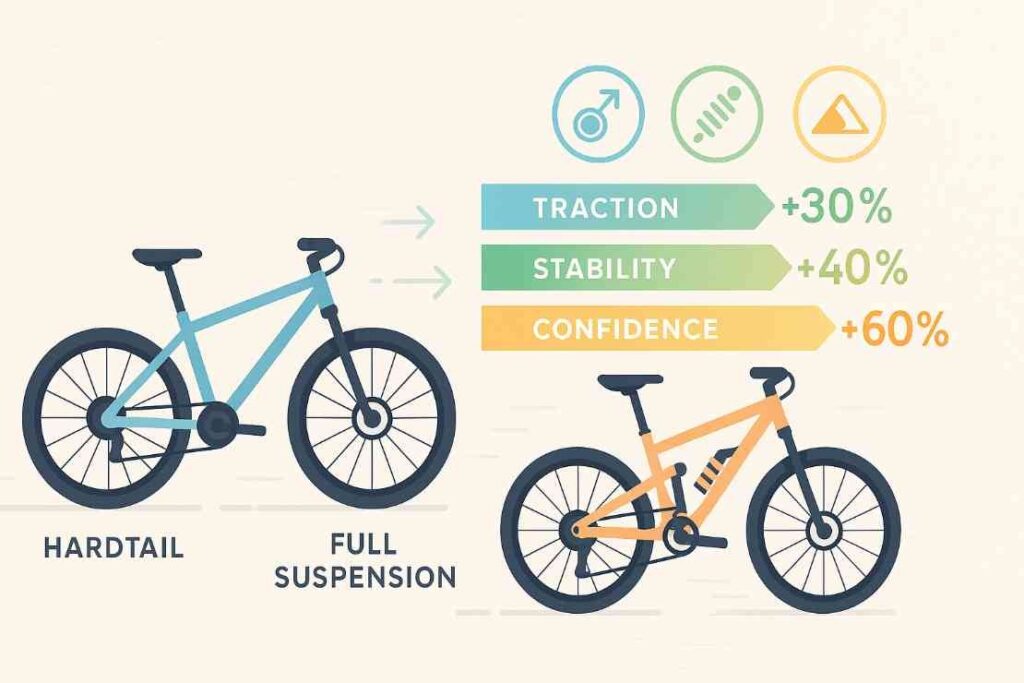
The signature advantage of a full suspension MTB is traction. Because both wheels stay in contact with the ground, you carry speed through chopped-up corners and rough straight-aways that would throw a hardtail off line. That extra grip inspires you to lean harder, brake later and accelerate sooner.
Second comes stability. The suspension absorbs square-edge hits that would jar your wrists or pitch you over the bars. On long descents you stay fresher, so your focus remains sharp. In technical rock gardens, the bike floats rather than ricochets, letting you choose creative lines or simply plough straight through.
Confidence is where it all adds up. A beginner quickly discovers that tricky root lattices and loose switchbacks feel attainable. An experienced rider pushes boundaries, landing bigger drops or carrying more pace into chutes. Whichever camp you’re in, you’ll notice fewer foot dabs and wider smiles.
Versatility rounds out the benefit list. One well-spec’d full suspension MTB can cover trail loops after work, an enduro race at the weekend and even a bike-park session during the holidays. Adjust rebound, dial in sag and swap tyres to match the mission.
Key Components of Full Suspension Mountain Bikes
Frame
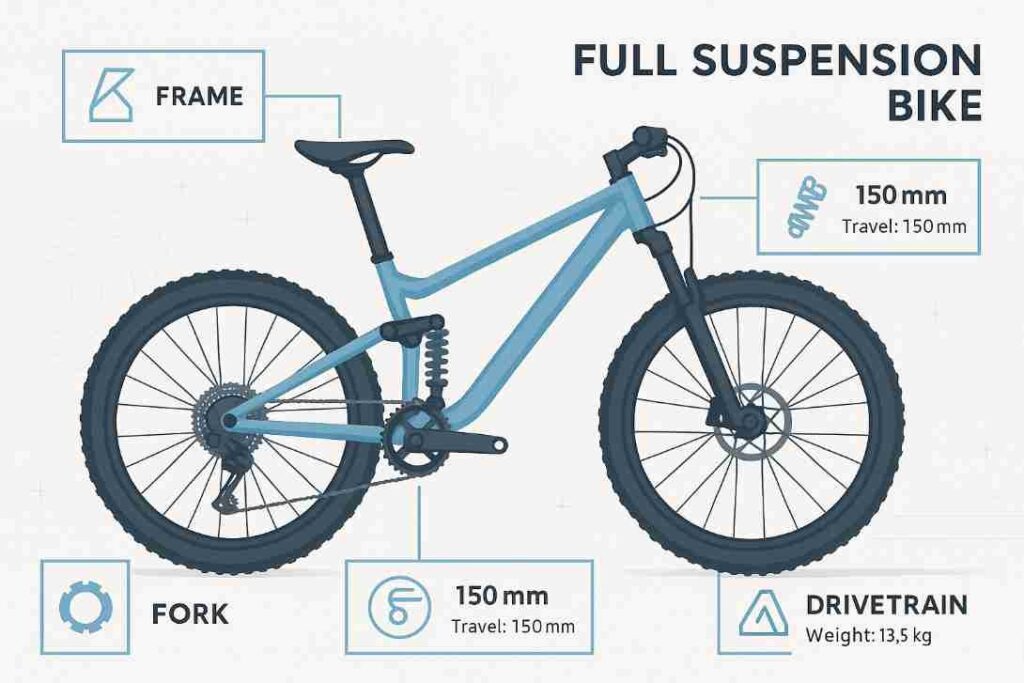
The heart of every full suspension MTB is its frame. Aluminium remains popular for its blend of affordability, durability and ride feel. Carbon-fibre frames trim weight and add stiffness, boosting acceleration and damping fine vibrations, albeit at a higher price. Both materials require linkages engineered to house pivots and bearings without flexing under load.
Fork
A modern suspension fork ranges from 100 mm to 200 mm of travel. Inside, an air spring or coil spring partners with an oil damping cartridge that controls compression and rebound. External dials let you fine-tune feel on the fly.
Rear Shock
Mounted close to the rear wheel, the shock performs the same job as the fork but must work in harmony with the frame’s pivot layout. Common architectures include single-pivot, Horst-link and virtual-pivot designs. All strive for a supple start, supportive mid-stroke and ramp-up near bottom-out.
Drivetrain
Most full suspension MTB drivetrains use a single front chainring paired with a wide-range cassette—simplifying shifting and cutting weight. A rear derailleur with clutch technology keeps the chain tight over bumps. Quality shifters provide crisp shifts even under load, crucial when your cadence varies every few seconds.
Features Enhancing Performance and Comfort
Wheels and Tyres
Sturdy 29-inch or 27.5-inch wheels, laced with robust spokes and wrapped in wide, knobby rubber, are your first point of traction. Tyre choice influences everything from cornering bite to rolling speed. Softer compounds grip well in wet roots, while firmer mixes roll faster on dry hardpack. Always match tread pattern to your local trails for maximum benefit.
Brakes
Hydraulic disc brakes dominate thanks to their power and modulation. Rotors typically span 180 mm up front and 160–180 mm at the rear for trail bikes, with downhill machines jumping to 200 mm for sustained braking on long descents. Good brakes let you ride faster by shortening stopping distance and boosting confidence.
Cockpit
Wide handlebars (760–800 mm) improve leverage; a short stem (35–50 mm) keeps steering quick. An adjustable seatpost—often called a dropper—lets you lower the saddle with a bar-mounted lever, clearing space to manoeuvre on descents, then pop it back up for efficient climbing.
Suspension Setup
Correct sag (the amount the suspension compresses under body weight) is essential. Start with 25-30 % of total travel for trail use, 30–35 % for gravity riding. Rebound should be fast enough to extend before the next hit yet slow enough to avoid a pogo effect. Spend time dialling these settings and your full suspension MTB will feel like it’s floating on rails.
Practical Considerations for Choosing a Full Suspension Mountain Bike
Match Terrain and Style
Picture your ideal ride. Is it a rolling cross-country loop, a technical moorland traverse or uplift-served downhill tracks? A lighter, shorter-travel bike excels at climbs and mileage, while an enduro rig favours chunky descents. Honest self-assessment leads to long-term happiness.
Assess Materials and Components
Scrutinise the spec sheet. Look for reputable suspension units with external adjustment, a drivetrain that uses readily available parts and wheels robust enough for your weight and riding aggression. A budget aluminium frame with high-quality suspension often rides better than a fancy frame hampered by entry-level shocks.
Prioritise Fit and Comfort
Stand over the bike flat-footed to check clearance, hop on to gauge reach, then pedal up and down the car park. Bars should feel naturally positioned; you shouldn’t be craning forwards or sitting bolt upright. An ill-fitting bike causes fatigue and dulls handling, so don’t compromise here.
Budget Wisely
Set a realistic ceiling, remembering you’ll need a helmet, pedals, shoes and maintenance tools. If your budget is tight, consider last year’s model or a seasonal sale. Some D2C brands such as Virbike deliver impressive component packages by selling direct, passing retail-margin savings on to you.
Maintain Regularly
Suspension components contain seals, oil and air chambers that demand periodic servicing—sometimes as early as every 50 hours of riding. Neglect leads to sticky performance and costly overhauls. Keep the drivetrain clean, inspect brake pads and torque all pivot bolts to prevent squeaks and premature wear.
Common Mistakes to Avoid
- Buying the wrong size because a deal seemed irresistible
- Ignoring sag and rebound adjustments, resulting in a harsh or wallowy ride
- Skimping on brake quality—power and consistency are non-negotiable on steep terrain
- Choosing tyres unsuited to local conditions, then blaming the bike for sliding out
- Forgetting that a bargain-basement shock upgrade later can eclipse the initial bike price
Real-World Scenario
Imagine you’ve set your sights on weekend trail exploration peppered with the odd enduro event. You weigh 80 kg and ride rooty woodland mixed with rocky bridleways. A 140–150 mm travel full suspension MTB hits the sweet spot. Choose an aluminium frame to save funds for a high-performance fork and shock. Fit 2.4-inch tyres—aggressive front, faster-rolling rear—plus 180 mm rotors for reliable stopping. Dial sag to 28 %, rebound two clicks slower than halfway, and you’re ready to chase friends all day without emerging battered.
Ready to ride further—without feeling it?
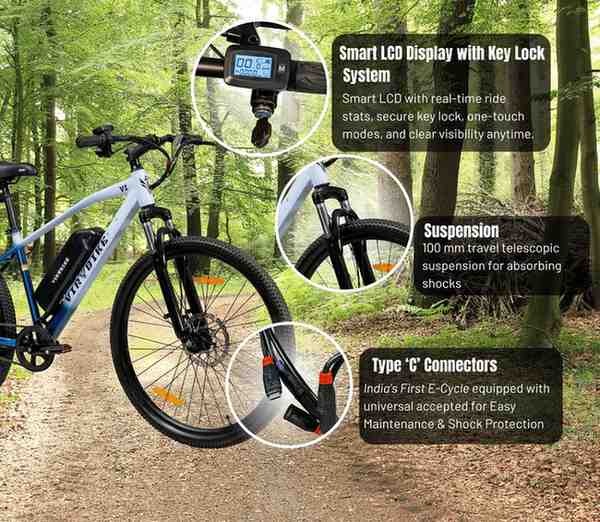
You’ve seen how suspension boosts traction, stability, and confidence on rough trails. Now add a battery to keep that flow going on climbs and long days. Virbike’s practical e-cycles bring cushioned control, smart pedal-assist up to city speeds, and worry-free range—so you can focus on the ride, not the grind.
Virbike line-up & indicative pricing (India)
- Virbike V1 — ex-showroom from ~₹34,999.
- Virbike V2 — ex-showroom typically ₹44,999–₹47,498 (variants).
- Virbike V3 — ex-showroom around ₹54,999.
Explore the Virbike V-Series
Compare features, performance, and pricing across our top electric cycle range.
Virbike V1
from ₹34,999- 36 V • 7.8 Ah removable battery
- Real-world PAS up to ~40 km
- Single-speed • Dual disc brakes • LCD display
Virbike V1+
~₹39,999- 36 V 10.4 Ah battery • Extended PAS range
- Dual disc brakes • Integrated headlamp
- Refined alloy frame • LCD display
Virbike V2
₹44,999 – ₹47,498- 36 V system • Removable battery (55/75 km options)
- Shimano 7-speed • Adjustable fork • Color display
- Alloy frame • Dual disc brakes
Virbike V3
₹54,999 – ₹56,990- 36 V in-tube 13 Ah battery
- PAS range ~65–70 km • MAXXIS tyres
- M5 LCD • Integrated headlamp & horn
*Actual range varies with rider weight, terrain, tyre pressure, and assist mode. Prices/specs subject to change.
Frequently Asked Questions
Q1. What is full suspension MTB?
A full suspension MTB is a mountain bike equipped with both a front suspension fork and a rear shock. This two-part system absorbs bumps from rough terrain, increasing comfort, traction and control compared with hardtail designs.
Q2. What is a full suspension MTB frame?
The frame houses front and rear suspension linkages, providing mounting points for a rear shock while maintaining stiffness and strength. Materials are typically aluminium or carbon-fibre, each balancing weight, cost and ride characteristics.
Q3. How do I set up suspension sag correctly?
Wear your normal riding kit, place the bike next to a wall, sit on it and bounce lightly to free stiction. Then measure how much travel compresses and adjust air pressure (or spring preload) until sag sits at roughly 25–30 % for general trail use.
Q4. Why choose full suspension over a hardtail for mixed terrain?
Full suspension maintains tyre contact on choppy surfaces, preserving speed and grip. On long rides it also reduces fatigue by isolating your body from continuous impacts, letting you tackle rougher trails comfortably.
Q5. My shock feels harsh after a few months—what’s wrong?
Oil and seals degrade with usage. If sag numbers drift or rebound feels sticky, it’s time for a service. Most manufacturers recommend a lower-leg/fork-air-can service every 50 hours and a full damper overhaul annually. Neglecting this maintenance compromises performance and can damage internal parts.If you’re looking for a reliable e-bike to tackle those rough trails with ease, check out the practical models at Virbike that combine comfort and durability—visit us at virbike.com to explore your options!