
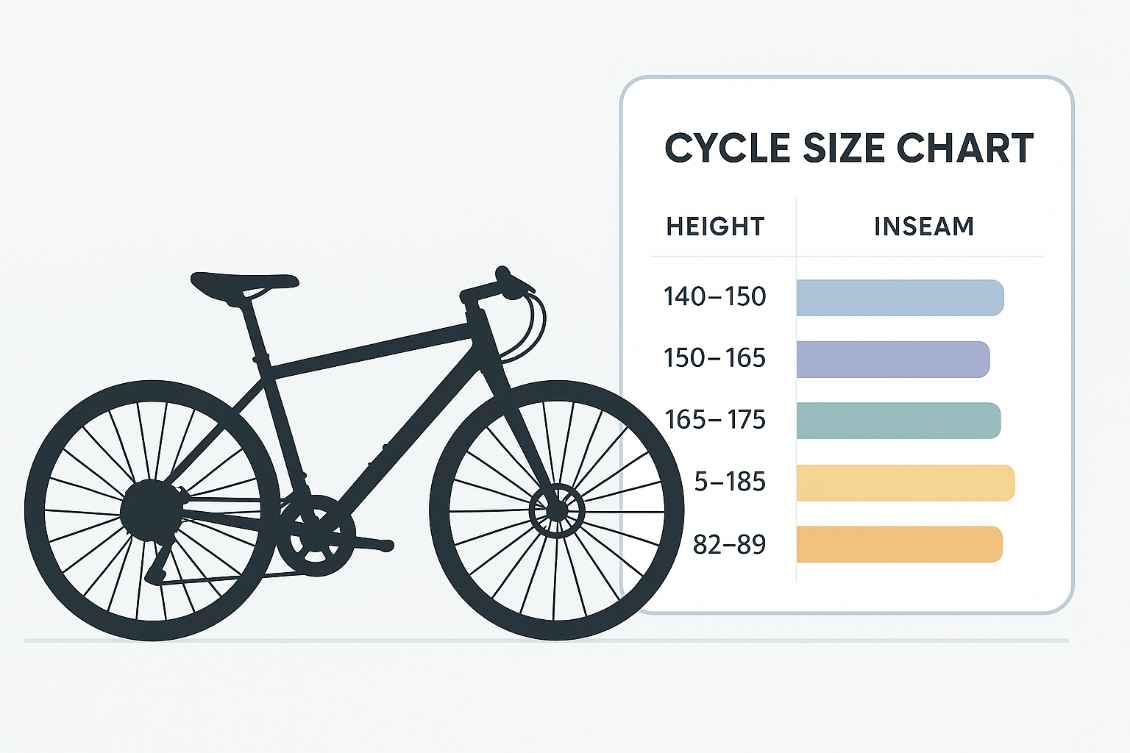
Buying a new bicycle should be exciting, not confusing. Many riders feel overwhelmed by frame numbers, wheel sizes, and tyre codes. A clear cycle size chart can help you choose the right bike, whether you are getting a child their first bike or upgrading your own.
Understanding Cycle Size Charts: What They Are and Why They Matter
A cycle size chart is a reference table that matches rider measurements to recommended bicycle dimensions. While charts vary by brand, they all help you select a frame and wheel size that keeps you comfortable and safe.
Ignoring the chart can lead to problems. A frame that is too large strains your back and shoulders. A frame that is too small can cramp your knees and reduce pedalling power. For children, the wrong size can hurt their confidence and increase the risk of falls. When you use a cycle size chart correctly:
- You maintain a natural riding posture.
- Your legs extend 80–90% of full length with each stroke, maximising efficiency.
- You enjoy better bike handling because reach and standover height are appropriate.
- Growing kids start with the right wheel diameter and build skills quickly.
The chart starts with accurate body measurements—height and inseam. Let us look at how to take them.
Explore the Virbike V-Series
Compare features, performance, and pricing across our top electric cycle range.
Virbike V1
from ₹34,999- 36 V • 7.8 Ah removable battery
- Real-world PAS up to ~40 km
- Single-speed • Dual disc brakes • LCD display
Virbike V1+
~₹39,999- 36 V 10.4 Ah battery • Extended PAS range
- Dual disc brakes • Integrated headlamp
- Refined alloy frame • LCD display
Virbike V2
₹44,999 – ₹47,498- 36 V system • Removable battery (55/75 km options)
- Shimano 7-speed • Adjustable fork • Color display
- Alloy frame • Dual disc brakes
Virbike V3
₹54,999 – ₹56,990- 36 V in-tube 13 Ah battery
- PAS range ~65–70 km • MAXXIS tyres
- M5 LCD • Integrated headlamp & horn
*Actual range varies with rider weight, terrain, tyre pressure, and assist mode. Prices/specs subject to change.
Get Your Tape Measure: Height and Inseam Essentials
You do not need fancy tools to size a bike at home. Gather these three items:
- A rigid tape measure (metal or stiff cloth)
- A large hard-back book or spirit level
- A wall and a pencil for marking height
Follow these steps:
- Stand barefoot against a wall, with your heels touching and spine straight.
- Place the book firmly between your legs, spine vertical, and raise it until it sits snugly against your pelvis—like a saddle.
- Mark the top edge of the book on the wall with the pencil. Measure from the floor to this mark: that is your inseam.
- Now measure your overall height from the floor to the crown of your head.
Record both numbers in centimetres, as most frame charts use metric lengths. For example, if you measure 172 cm tall with an 80 cm inseam, keep those figures handy when consulting any cycle size chart.
For instance, a child measuring 105 cm high with a 45 cm inseam fits into the 16-inch wheel category on most kids’ charts. An adult of 180 cm usually rides a 48–50 cm frame, depending on bike style.
Kid-Friendly Sizing: Matching Wheels to Growing Legs
Children’s bikes are sized by wheel diameter, not frame length. A child’s proportions differ from an adult’s, and wheel size offers a simpler visual cue for parents. The most common wheel diameters and matching stats are:
- 12-inch wheels – ages 2–4, or 85–100 cm tall
- 14-inch wheels – ages 3–5, or 95–110 cm tall
- 16-inch wheels – ages 4–6, or 105–120 cm tall
- 18-inch wheels – ages 5–8, or 115–135 cm tall
- 20-inch wheels – ages 6–10, or 125–145 cm tall
- 24-inch wheels – ages 7–11, or 130–142 cm tall
Use age as a loose guide; height and inseam are the real deciding factors. After narrowing it down with the cycle size chart, always have the child try the bike. They should be able to:
- Straddle the top tube with both feet flat on the ground.
- Reach the handlebars without locking their elbows.
- Pedal a full revolution without knees hitting elbows or the handlebar.
If the fit feels borderline, choose the smaller size. It is easier and safer for a child to grow into a bike than to manage one that is too large.
Finding the Perfect Frame for Grown-Up Riders
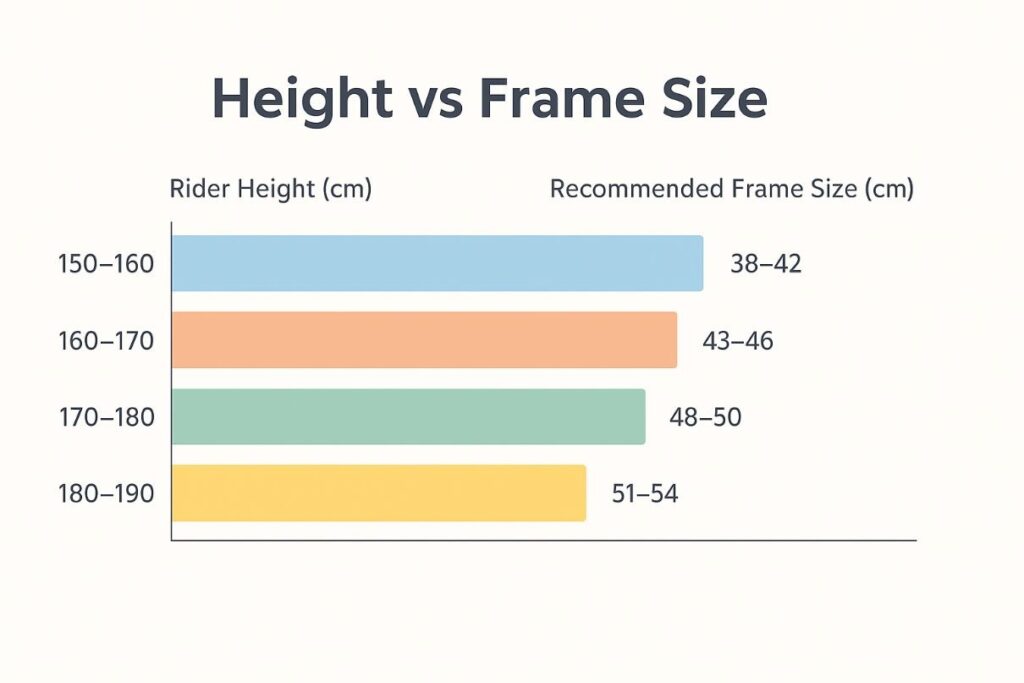
Adult frames rely on overall height but also consider inseam.
- 152–163 cm rider: 38 cm frame
- 163–173 cm rider: 43–46 cm frame
- 173–180 cm rider: 48–50 cm frame
- 180–193 cm rider: 53 cm frame
If you sit between sizes, consider your riding style. A nimble city commuter or mountain bike often feels better one size down for manoeuvrability, while a long-distance road bike benefits from a slightly larger option for torso stretch and breathing.
Many manufacturers list a maximum rider weight capacity. A typical limit is 110 kg, so verify the bike’s rating if you are close to that figure.
Tyre Sizes Decoded: Centimetres Versus Inches
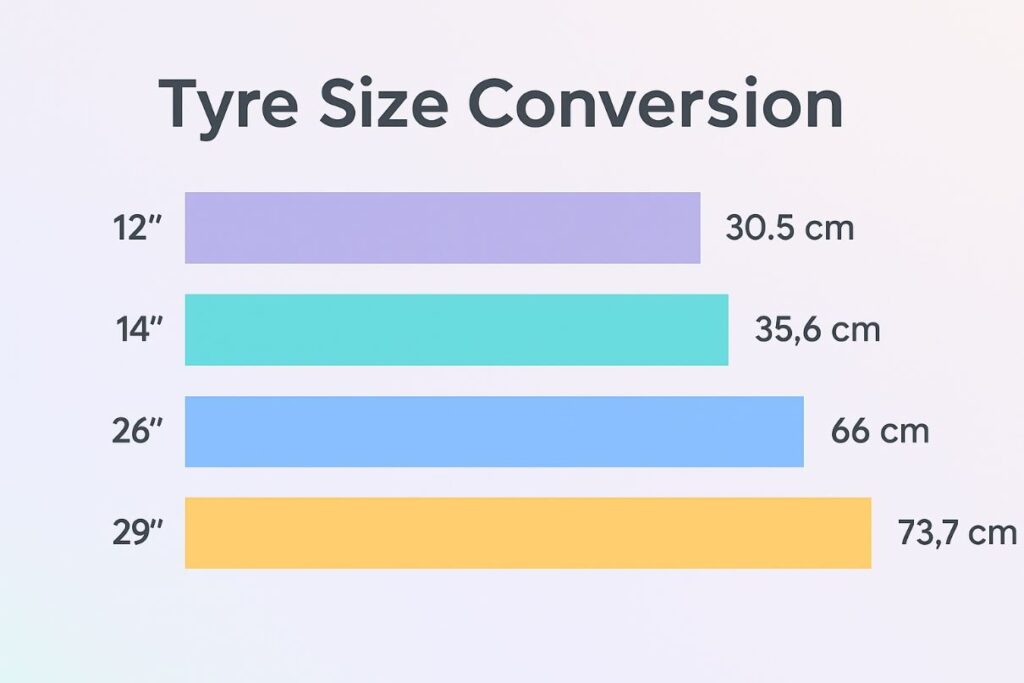
Tyre size affects overall bike geometry and handling. Children’s and many hybrid bikes list tyres in inches (12T, 20T, 26T), while high-performance models may use centimetres or millimetres. Here is a handy conversion:
- 12T = 30.5 cm
- 14T = 35.6 cm
- 16T = 40.6 cm
- 18T = 45.7 cm
- 20T = 50.8 cm
- 24T = 61 cm
- 26T = 66 cm
- 27.5T = 69.9 cm
- 29er = 73.7 cm
Match tyre diameter to the frame. For example, a 26T wheel usually fits small or medium adult mountain bike frames, while 700c road wheels pair with traditional 50 cm and above frames. Choosing the wrong tyre size can affect handling or make the bike incompatible with brakes and forks.
Road, Mountain, or Hybrid? How Cycle Size Charts Differ

Every bike category has slight geometry tweaks, so size advice varies.
Road bikes (RO): They have a longer top tube and lower bar position for better aerodynamics. You may downsize by 1–2 cm compared to your hybrid size to maintain comfortable reach without over-stretching your hamstrings.
Mountain bikes (MTB): These have slacker head angles and shorter seat tubes for control on rough trails. If you straddle two sizes, a smaller MTB offers better cornering agility.
Hybrid or city bikes: Designed for an upright posture, they have longer head tubes. Many riders choose the larger of the two recommended frames for a relaxed position during commutes.
Leg inseam remains the common factor—always check that number against the manufacturer’s cycle size chart. If your inseam is shorter than average for your height, choose a smaller frame; if longer, size up.
Handy Tools and Expert Help for Choosing Correctly
Modern shoppers have several resources for decoding a cycle size chart:
- Online size calculators: Enter your height (and sometimes inseam) into a form, and the algorithm provides a starting frame recommendation. Virbike’s calculator even refines results by bike category for a personalised suggestion.
- Printable fit guides: Some brands offer PDF templates. Print them, stick them to a wall, and match body marks to recommended frames.
- In-store consultations: A brief session with a knowledgeable technician can help. They will measure you, discuss riding goals, and set saddle height on a demo bike so you can feel the difference.
Whichever tool you use, treat the outcome as a starting point. Always verify standover clearance and reach before committing, especially if component swaps (stem length, seatpost layback) are limited.
Common Pitfalls to Dodge
Even with an excellent cycle size chart, riders often make these mistakes:
- Relying only on age when buying a child’s bike.
- Forgetting inseam and basing everything solely on overall height.
- Buying “room to grow” wheels two sizes too large for a child.
- Ignoring maximum weight ratings.
- Skipping the test ride because an online calculator said it would fit.
Avoid these blunders, and your first ride will be a success.
If you still feel cramped despite following the cycle size chart, our team at Virbike can help you find the perfect fit with our range of electric bicycles. Visit us at virbike.com to explore your options and ensure your ride is comfortable and practical!
Explore the Virbike V-Series
Compare features, performance, and pricing across our top electric cycle range.
Virbike V1
from ₹34,999- 36 V • 7.8 Ah removable battery
- Real-world PAS up to ~40 km
- Single-speed • Dual disc brakes • LCD display
Virbike V1+
~₹39,999- 36 V 10.4 Ah battery • Extended PAS range
- Dual disc brakes • Integrated headlamp
- Refined alloy frame • LCD display
Virbike V2
₹44,999 – ₹47,498- 36 V system • Removable battery (55/75 km options)
- Shimano 7-speed • Adjustable fork • Color display
- Alloy frame • Dual disc brakes
Virbike V3
₹54,999 – ₹56,990- 36 V in-tube 13 Ah battery
- PAS range ~65–70 km • MAXXIS tyres
- M5 LCD • Integrated headlamp & horn
*Actual range varies with rider weight, terrain, tyre pressure, and assist mode. Prices/specs subject to change.
Frequently Asked Questions
Q1. How to calculate cycle length?
Track at least three consecutive cycles, add the number of days together, and divide by the number of cycles. For bicycles, multiply inseam in centimetres by 0.66 to estimate road-bike frame size in centimetres.
Q2. What is the average cycle length?
An average adult rider of 170 cm usually fits a 50 cm hybrid frame or a 54 cm road frame, depending on proportions.
Q3. How can I apply these measurements when shopping online?
First, take accurate height and inseam measurements at home. Enter them into the retailer’s calculator or cross-check the brand’s cycle size chart, then compare the result with user reviews before ordering.
Q4. Why pick a smaller frame instead of a larger one when you are between sizes?
A slightly smaller frame allows for adjustments with a longer seatpost or stem and maintains safe standover clearance. An oversized frame limits reach adjustments and can strain your back.