
Modern lithium‑ion batteries sit at the heart of your favourite tech – from nippy electric cycles to cordless tools. Yet many owners only think about them once the low‑battery warning flashes. Understanding how a battery cycle works, why the cycle count matters and how you can influence it will help you squeeze every last watt of value out of your investment. Below you’ll find a practical, jargon‑free guide that takes you from the basics of battery cycles all the way to hands‑on maintenance tips for electric bikes.
Understanding Battery Cycles

A battery cycle is a full round‑trip of the battery’s energy, but not necessarily in one sitting. Imagine you drain your e‑cycle to 50 % on Monday, recharge overnight, and repeat the same pattern on Tuesday. Only after the second 50 % discharge have you used 100 % of the original capacity, completing one charge cycle. Depending on your routine, a single cycle can unfold in a few hours or over several days.
Lithium‑ion cells are designed for a finite number of these cycles. Manufacturers specify a “maximum cycle count”, the point at which the battery should still hold around 80 % of its original charge. Once past that threshold, chemistry fatigue sets in, internal resistance rises and runtime starts to shrink. You can keep using the pack, but you will notice shorter sessions between charges and slower performance surges in devices that demand peak power quickly.
For owners, the cycle count becomes a simple, built‑in health gauge. It tells you roughly where the battery sits on its lifespan timeline, whether you should tweak your charging habits, and when it makes financial sense to schedule a replacement.
Battery Cycle Limits and Replacement
Every lithium‑ion battery gradually loses active material each time ions shuttle between positive and negative electrodes. The maximum cycle specification simply marks the point where this residue reaches an acceptable threshold. For example, a typical e‑cycle battery rated for 600 cycles should still store four‑fifths of its launch‑day capacity at cycle 600. After that, decline usually accelerates. Runtimes shorten noticeably, and peak performance might throttle on heavy workloads.
Replacing the battery once you hit the limit protects both productivity and hardware value. Swap‑outs are cheaper than replacing the entire bike, and a fresh pack revives confidence on long rides. Virbike’s models use Intube Li‑ion batteries designed to deliver extended range (up to 55 km on certain models and 75 km on others) and come with fast‑charging support, which helps maximise usable capacity while keeping cycle counts lower. If your e‑bike’s range is starting to sag, check the cycle count and weigh up the cost of a replacement versus the convenience of a longer‑lasting pack.
Battery Features in Electric Cycles
Lithium‑ion technology unlocked the explosive growth of electric cycles (e‑cycles). Compared with older lead‑acid units, lithium packs more energy per kilogram, delivers higher voltage under load and shrugs off the “memory effect” that once plagued nickel‑cadmium batteries. The headline figure you’ll see in product specs is capacity, expressed in amp‑hours (Ah) or watt‑hours (Wh). Most commuter e‑cycles ship with 6 Ah to 9 Ah packs, the sweet spot that balances weight against range. A 9 Ah battery stores 50 % more charge than a 6 Ah, translating to longer rides or steeper climbs before assist cuts out.
Capacity is only half the story. Motor power, battery management system (BMS) quality and charging speed influence how efficiently that energy gets from cell to motor. Virbike’s BLDC motors provide both throttle and walk‑assist, with speed limited to 25 km/h for compliance. The bikes come with a portable, home‑charging socket that replenishes the battery in about 2.5 hours, and the 5‑level PAS LCD display provides real‑time speed and range information. Choose a battery spec that comfortably exceeds your habitual commute or weekend trail loop. Under‑specifying means you’ll run out of juice or find yourself constantly tethered to the charger, both of which chew through cycle counts faster.
Practical Applications in Electric Cycles

Take a mid‑range 250 W e‑cycle running a removable 36 V, 9 Ah pack (roughly 324 Wh). Under moderate pedal assist, many riders can expect around 50 kilometres of real‑world range. Swap that battery for a 6 Ah version, and you may see range drop to roughly 33 kilometres, especially if hills or headwinds enter the mix. Manufacturers lean heavily on these numbers in marketing; you’ll find bold headlines about “up to 50 miles per charge” followed by fine print listing rider weight, terrain and assist level. As a buyer, focus on your riding profile rather than headline extremes. Roomy capacity that covers your furthest regular ride keeps anxiety low and extends lifespan because partial cycles stack up more slowly.
Virbike’s line‑up includes models like the V3 Desert Raptor, which pairs a 36 V 10 Ah Intube Li‑ion battery with an M5 LCD display and full‑rim alloy mudguards. Its lightweight aluminium alloy frame and 250 W hub motor are designed for urban and leisure riding. With a range of 55–75 km per charge and fast‑charging capability, it offers a clear example of how a higher‑capacity battery translates to real‑world range. Explore Virbike’s models to find the right fit for your commuting or adventure needs.
Maintenance and Optimisation
You can’t stop capacity fade entirely, but you can slow it using a few smart habits:
- Aim for the “Goldilocks” charge window
Keeping lithium‑ion between roughly 20 % and 80 % state‑of‑charge reduces chemical strain. Full charges are fine occasionally – for instance, before a long weekend ride – but avoid parking the bike at 100 % for days. Some Virbike chargers include a storage mode that automatically caps the charge at around 80 %. - Shallow rather than deep cycles
Frequent top‑ups that prevent the battery from hitting single‑digit percentages add up to gentler cycles. Your e‑cycle’s battery meter moves the same total amount, yet the chemistry experiences less severe swings. - Store at mid‑charge
If you’re not riding during winter, leave the battery around half full and in a cool, dry environment. Extreme heat accelerates degradation; freezing temperatures can also stress cells. - Use built‑in smart charging
Many modern e‑cycle chargers, including Virbike’s portable units, feature “fast‑charge” or “storage” modes. Activate them whenever possible to prevent over‑charging and balance cells efficiently. - Monitor cycle count routinely
Check your cycle count on the bike’s LCD display or companion app. Plan ahead for replacement around the rated limit to avoid unexpected range loss. - Service and clean contacts
For removable packs, wipe the terminals with a dry cloth to ensure efficient energy transfer. Loose or corroded contacts increase resistance, causing heat and wasting power.
For more detailed care guidelines and personalised support, Virbike’s website offers helpful resources, and you can request a call back directly from their site to speak with an expert.
Common pitfalls to avoid
- Running the pack flat every ride because “I paid for the range.” Consistent deep discharges hurt longevity more than using only half the capacity and charging little and often.
- Ignoring the charger’s instructions. Trickle charging overnight with a non‑smart brick can overheat cells; conversely, yanking the plug seconds after the green light flicks on denies the BMS time to balance cells.
- Forgetting firmware updates. Some e‑cycle brands push BMS updates through companion apps. Staying current can improve charge efficiency and fault detection.
When to replace an e‑cycle battery
Most lithium‑ion packs in electric bikes are rated for roughly 500–700 cycles. Using the earlier commute example, you’d nudge that limit after about four years. Indicators it’s time for a new pack include:
- Noticeably reduced assist range on routes you’ve ridden for months.
- The charger “finishes” far sooner than it used to, hinting capacity shrank.
- Error codes related to cell imbalance or voltage sag under load.
A fresh battery restores confidence and resale value, and it’s almost always cheaper and greener than discarding the entire bike.
Explore the Virbike V-Series
Compare features, performance, and pricing across our top electric cycle range.
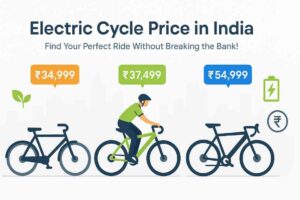
Virbike V1
from ₹34,999- 36 V • 7.8 Ah removable battery
- Real-world PAS up to ~40 km
- Single-speed • Dual disc brakes • LCD display
Virbike V1+
~₹39,999- 36 V 10.4 Ah battery • Extended PAS range
- Dual disc brakes • Integrated headlamp
- Refined alloy frame • LCD display
Virbike V2
₹44,999 – ₹47,498- 36 V system • Removable battery (55/75 km options)
- Shimano 7-speed • Adjustable fork • Color display
- Alloy frame • Dual disc brakes
Virbike V3
₹54,999 – ₹56,990- 36 V in-tube 13 Ah battery
- PAS range ~65–70 km • MAXXIS tyres
- M5 LCD • Integrated headlamp & horn
*Actual range varies with rider weight, terrain, tyre pressure, and assist mode. Prices/specs subject to change.
Frequently Asked Questions
Q1. What is a battery cycle?
A battery cycle is one complete use of 100 % of a battery’s original capacity, whether that energy is drained in a single sitting or over several partial discharges followed by recharges.
Q2. How long is a battery cycle?
There’s no fixed time; a cycle finishes once cumulative discharge adds up to 100 %. Depending on your usage pattern it could be hours, days or even a week.
Q3. What is a deep cycle battery?
A deep cycle battery is built to withstand regular, extensive discharges down to a low state‑of‑charge without damage, commonly used in marine craft and solar storage rather than laptops or e‑cycles.
Q4. How do I check the cycle count on my e‑bike’s battery?
Many e‑bikes display the cycle count and battery health on the on‑board LCD screen or through a companion smartphone app. Consult your bike’s manual or app to locate the cycle‑count indicator and plan maintenance accordingly.
Q5. What’s the benefit of choosing a higher capacity e‑cycle battery?
A larger capacity pack extends pedal‑assist range, reduces how often you recharge and slows the rate at which full cycles accumulate, prolonging overall battery lifespan.
Q6. My e‑cycle range suddenly dropped; could the battery be at maximum cycles?
Yes. Once a pack nears or exceeds its rated cycle count, capacity can fall below 80 % and voltage may sag under load, producing shorter rides. Checking the cycle count and considering a replacement is the quickest way to restore performance. If you’re noticing a drop in your e‑bike’s range, it might be time to check your battery cycles.
Explore Virbike’s reliable e‑cycles, which offer quick charging and ranges up to 75 km per charge, at virbike.com to find the perfect model for your commuting and leisure needs.